

Almost every hair vendor uses the phrase, but very few explain it. Here is where the term comes from, why it costs more, and how to test a bundle before you pay for one.
Imagine you buy a 22-inch bundle. You measure it with a tape and it’s exactly 22 inches. But once it’s sewn in, it looks more like 18 inches. That isn’t a scam, and the bundle isn’t faulty. It’s what usually happens when you buy hair without checking one thing: how the different lengths inside the bundle were sorted before it was packed and sold.
That sorting has a name: double drawn. You’ll see it in almost every product title, sitting next to words like “raw”, “virgin”, “Remy” and grading numbers, yet hardly anyone explains it. Most buyers read it as another way of saying “good hair” and go straight to checkout. That habit is exactly what turns a fairly priced 22-inch bundle into one that only looks like 18 inches once it’s on your head.
Everyone sells it. Almost nobody explains it
“Double drawn” has been used as a selling point for so long, and explained so rarely, that most buyers no longer stop to ask what it means. It sits in product titles next to “raw”, “virgin”, “Remy”, “12A” and “grade 10” like a row of badges, and the hope is that you’ll read it as “good” and move on.
So let’s slow down. Double drawn is not a grade. It is not a texture. It is not the country the hair came from, and it is not a promise about chemicals. It tells you one thing only: how the different lengths inside a bundle were sorted. Once you get that, a lot of the confusing hair-shop language starts to make sense.
If you want the full picture of how this fits with the other labels, we explain it separately in RAW, VIRGIN, SDD: What are you actually buying? The short version: those words describe the hair’s history, while “drawn” describes how the hair was sorted. Those are two different questions. A bundle can be raw and single drawn. It can be processed and double drawn. Vendors mix these terms up all the time, sometimes by accident and sometimes on purpose.
Why no ponytail on earth is one single length
To understand drawing, start where the hair starts: on somebody’s head. Pick up a small section of your own hair at the back and look at the ends. They’re not level. Some strands reach the bottom of the section and some stop well short. That isn’t damage or breakage; it’s just how hair grows. Every hair root on your scalp runs on its own schedule, separate from its neighbours. Here’s how it works. Every strand cycles through a growth phase, a transition phase, and a resting phase, and since they all started at different times, they’re all at different stages right now.
The growth phase is the one that decides length. A strand keeps growing for as long as that phase lasts, then it stops, rests, and eventually falls out so a new one can take its place. The length any single hair can reach is simply the length it manages before that growth phase ends, which is why the hair on your arms will never reach your shoulders, however patient you are.
Now multiply that by roughly a hundred thousand hairs, each on its own clock, and you get the fact the whole extension industry is built around: nobody grows a perfectly even ponytail. Cut hair off someone’s head in one go and you get a mix. Some strands are full length, some are two-thirds of it, some are a third, and some are barely an inch. The bundle is thick near the top, where all those strands overlap, and thin at the bottom, where only the longest strands are left. That’s the raw material every vendor starts with, before any sorting happens.
Hair leaves the head single drawn. Double drawn is something that happens to it afterwards, by hand, and it costs money.
Where the word “drawn” comes from
The word is old, and it was borrowed from the textile trade. To “draw” fibre means to pull it through a comb or a bed of steel pins (called a hackle) so the strands line up and the short ones get left behind. Wool and flax workers have done this for centuries. Hair factories simply took over the tool and the word.
So when a bundle is drawn, a worker ties the cut ponytail at the root end and pulls it again and again through the pins. Short strands catch in the pins and get lifted out. Long strands pass through. Every pass makes the bundle more even, and also lighter, because every short strand removed is weight that leaves the bundle for good.
Count the number of passes and you have the whole vocabulary:
Single drawn
One round of drawing. The shortest, most useless strands are pulled out so the bundle isn’t full of stubble, and that’s where it stops. What’s left is a natural mix of lengths. As a rough rule of thumb in the industry, about half the strands in a single drawn bundle reach the advertised length, while the other half sit somewhere below it. Hang it up and you can see the shape: thick at the top, then thinning gradually to a soft
point.
Double drawn
Many more rounds, and here’s the part people don’t picture: on good hair, this is done by hand, strand by strand, by a person sitting with the bundle across their lap picking out anything that’s too short. The goal is an even bundle. The numbers differ from factory to factory, but most of the trade quotes something like seventy to ninety percent of strands landing at or near the full advertised length. Hang that bundle up and the shape changes completely: it falls almost straight down and ends in a blunt, heavy line instead of a point.
Already know which sorting you need? Make a purchase from our double drawn and super double drawn bundles.
The maths behind the price tag
This part will change how you shop, so stay with me. A bundle is sold by weight, usually 100 grams. Those 100 grams have to come from somewhere. In a single drawn bundle, a good share of that weight is short strands: perfectly healthy hair sitting in the top half of the
bundle, adding grams but adding nothing to the length you can actually see.
Now imagine pulling out every one of those short strands. What you’re holding is much thinner, and it weighs far less than 100 grams. To get back to 100 grams of only long hair, the factory has to keep sorting more ponytails and gathering the long strands from each one. Depending on the hair and the length wanted, two, three, or sometimes more ponytails go into making the weight that one single drawn bundle would have reached on its own. That’s also why double drawn bundles, especially long ones, are often mixed from more than one person’s hair. There simply isn’t enough long hair on one head.
So you’re paying for three things at once: the extra raw hair, the work of sorting it by hand, and the hair that got thrown out of the bundle along the way. That’s the premium. It isn’t just a marketing markup.
And here’s the flip side, and the reason experienced buyers happily pay it: 100 grams of double drawn hair gives you more visible fullness than 100 grams of single drawn hair, because none of the weight is hiding at the top. Stylists notice this straight away. A full sew-in that would take four single drawn bundles often finishes with three double drawn ones. Two double drawn bundles can carry an install that needed three.
You pay more per bundle and frequently need fewer of them, which makes the real price difference much smaller than the price on the shelf suggests. If you’d rather see that saving worked out for a specific length, make a purchase and our fitting guide on the product page will show you exactly how many bundles your install needs.
Say it plainly
Single drawn: you’re buying 100 grams of hair, and some of it is short.
Double drawn: you’re buying 100 grams of hair, and nearly all of it is long.
Same weight on the scale. A very different amount of hair where your mirror can see it.
How the sorting is actually done
Ponytails arrive at the factory tied at the root end and tagged with a length. To draw a bundle, a worker holds the root end and combs the ponytail through a hackle, which is a block covered in upright steel pins. Short strands catch in the pins and stay behind; long strands pass through. For single drawn hair, one pass is usually enough. It removes the shortest, most unusable strands and stops there.
For double drawn hair, the work carries on by hand. The worker spreads out what’s left, measures it against a fixed length, and takes out anything that’s too short, one strand at a time, again and again, until most of what remains matches the target length. The hair that’s taken out isn’t thrown away. It’s usually sold as shorter hair or mixed into other products. But as far as the bundle being built is concerned, that hair is lost weight, and it has to be replaced from another ponytail to reach the 100-gram total.
This is why the price gap grows with length instead of staying the same. At twelve inches, most of a person’s hair qualifies and sorting is quick. At twenty-eight inches, only the longest strands on any head reach the target, so much more hair, often from several ponytails, has to be sorted to make one finished bundle. The price gap between an 18-inch double drawn bundle and a 28-inch one comes from all that extra hair, not just
ten extra inches of length.
Machine-drawn and hand-drawn hair are sometimes both labelled double drawn, but they’re not the same thing. Machines are faster but rougher on the outer layer of each strand (the cuticle), because they grab and pull instead of picking strand by strand. That can leave more breakage even when the length is right. Hand sorting is slower and costs more, and it’s the main reason labour cost is built into a double drawn bundle’s price.
What double drawn does not tell you
A common mistake is treating the double drawn label as if it settles everything. It doesn’t. It’s just one detail among several, and it says nothing about the others.
It says nothing about which way the strands are facing
Each strand is covered in tiny scales, a bit like roof tiles. That’s the cuticle. That’s what Remy describes – hair collected so every cuticle still runs in the same direction, root to tip, the way it grew. When the scales all face the same way, strands slide past each other and the hair resists tangling. When they’re mixed up, the hair fights itself and tangles at the back of your neck, no matter how even the lengths are. A bundle can be perfectly double drawn and still be non-Remy, and it will still knot.
It says nothing about chemicals
Double drawn hair is routinely bleached, acid-bathed, steam-processed or permed into a texture. Even length and virgin hair are two unrelated claims.
It says nothing about whether the hair came from one person
In fact, as we saw earlier, double drawn bundles are often built from several people’s ponytails combined to reach the weight and length. If
single-donor hair matters to you, that’s a separate question, so ask it separately.
It says nothing about how long the hair will last on its own
That depends on the condition of the cuticle, how the hair was processed, and how you treat it. Double drawn ends do tend to last longer in
practice, but for a fairly boring reason: blunt ends have more strands sharing the rubbing, so they thin out more slowly than a thin, pointy tip. That advantage is easy to lose in six weeks of dry combing, which is why we keep How to make your hair last longer next to every buying guide we publish.
Five ways to test a bundle yourself
You can’t check these claims from a product photo. Hair photos are usually taken wet, clamped down, and lit from behind, which hides exactly the thinning you’re trying to spot. Here’s what actually works, in the shop or the moment the parcel opens.
1. The hang test
Hold the bundle by the top edge (the stitched part), let the hair fall freely, and step back far enough to see the overall shape instead of the individual strands. Double drawn hangs like a column and ends in a straight line. Single drawn hangs like a cone and ends in a point. This one test catches most of it.
2. The fingertip test
Gather the hair into a loose ponytail in one hand, then slide your other hand down to the last two inches and squeeze. You’re feeling for thickness. Double drawn ends feel like rope. Single drawn ends feel like a brush that has lost half its bristles.
3. The middle-of-the-bundle test
This is the one vendors don’t expect. Hold the bundle in the middle and push the hair above your hand upwards, so the part below stands on its own. In a single drawn bundle you’ll see a clear step where a mass of short strands ends. In a double drawn bundle, the thickness hardly changes.
4. The light test
Hold the bottom third up to a window or a phone torch. Thin ends go see-through, and you can look straight through them. Blunt ends hold a shadow.
5. The measure test
Pick ten random strands from different points along the top edge. Don’t pick the longest ones you can find, which is what everybody does without thinking. Measure each one from the top edge down. If most of them land within an inch or two of the advertised length, the claim is good. If half of them are four or five inches short, you’re holding single drawn hair, whatever the packaging says.
Four questions worth sending to a vendor before you pay
• Is this single drawn, double drawn or super double drawn, and roughly what percentage of strands reach full length?
• Is it Remy? In other words, are all the strands facing the same way, root to tip?
• Is the hair from one person, or blended from several?
• Can you send an unedited video of the bundle hanging loose, shot dry, showing the last four inches?
A vendor who knows their supply chain will answer all four in one message. A vendor who only replies “premium quality, 12A grade” has told you something useful too.
So which one should you actually buy?
This is where the industry lets buyers down: double drawn is sold as better for everyone, and it isn’t. It’s better for certain results. Single drawn hair exists for a real reason. Its natural mix of lengths works like free layering, and layering is what makes hair look like it grew out of your scalp instead of being sewn onto it.
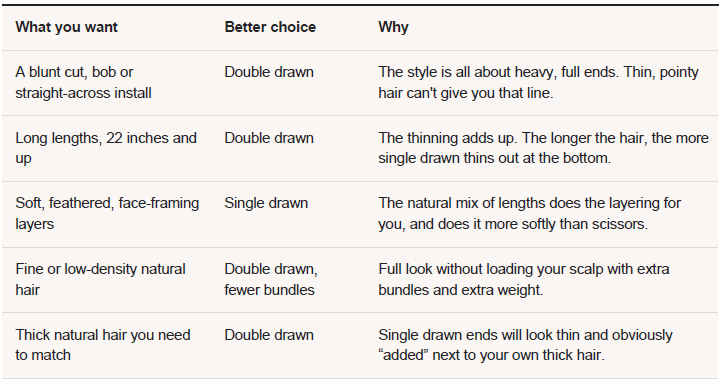
Matched your need to a type in the table above? Make a purchase and choose your length, texture and colour at checkout.
There’s also a middle option for anyone who wants the softness of single drawn hair without the thin ends: buy single drawn hair two to four inches longer than you need, then have a stylist cut it back to your target length. That cuts off the part where the short strands run out, so your install starts from the thick part of the hair instead of the point. It costs less than buying double drawn outright, but you lose that two to four inches, and for a shorter or temporary install, that trade is often worth it.
Reading a vendor listing correctly
Listings rarely say how the hair was drawn in plain words, so it helps to know what the shorthand usually means. Grading letters like “12A” or “10A” aren’t standard across the industry, and they don’t reliably tell you how the hair was sorted. Treat them as the vendor’s own marketing level, not a checked fact. “SDD” or “super double drawn” should mean the most even level described above, but since nobody outside the
industry enforces the term, ask the vendor what percentage of strands reach the advertised length instead of taking the abbreviation at face value.
Weight versus length is a handy cross-check. 100 grams of double drawn hair at a given length will usually look and feel clearly fuller in your hand than 100 grams of single drawn hair at the same length, because none of the weight is hiding in short strands near the top. If a listing’s photos show a bundle that looks thin for its stated weight and length, flag it before ordering, whatever the title says.
Where the value actually shows up
The benefit of buying double drawn hair the right way isn’t obvious on day one. Freshly installed hair usually looks good however it was sorted. It shows up months later: are the ends still full? Do you need a trim just to fake fullness back into a thinning tail? Does the hair still look like the length you paid for?
But that depends on more than the sorting. The condition of the cuticle and your day-to-day care decide how long any bundle lasts, double drawn or not. Blunt, full ends handle wear better than thin ones, but they’re not indestructible. Poor care, like daily dry brushing, no protective cover at night, or heat with no protection, will thin out even the best-sorted bundle way ahead of time. The steps in How to make your hair last longer apply whichever type you buy, and they matter more the more you’ve spent on the hair.
FAQ On What does “double drawn” actually mean?
Is double drawn the same as virgin or raw hair?
No. Drawing is about sorting by length. Virgin and raw are about chemical treatment and where the hair came from. Every combination exists. If both matter to you, check both, and read RAW, VIRGIN, SDD: What are you actually buying? before you shop.
Is double drawn hair heavier on my scalp?
Not per bundle, because 100 grams is 100 grams. But since the fullness shows more, you usually need fewer bundles, which means less total weight on your hair and less pulling on your edges. That’s a real benefit if your hairline is fragile.
Can double drawn hair be layered?
Yes, and often it should be. A blunt column suits some faces and overwhelms others. With double drawn hair, your stylist controls the layering on purpose, instead of you getting whatever shape the person’s natural hair growth happened to give.
Why do two vendors quote different percentages for the same term?
Because nobody sets a standard for it. Seventy percent full length and ninety percent are both sold as “double drawn”, and nobody is breaking a rule. That’s exactly why the hang test and the middle-of-the-bundle test matter more than the label.
Does double drawn hair last longer?
Usually, yes. Blunt ends spread the rubbing across more strands, so they thin out more slowly. But the condition of the hair and your own care matter more than the sorting does. Bad care ruins double drawn hair just as fast as any other hair.