
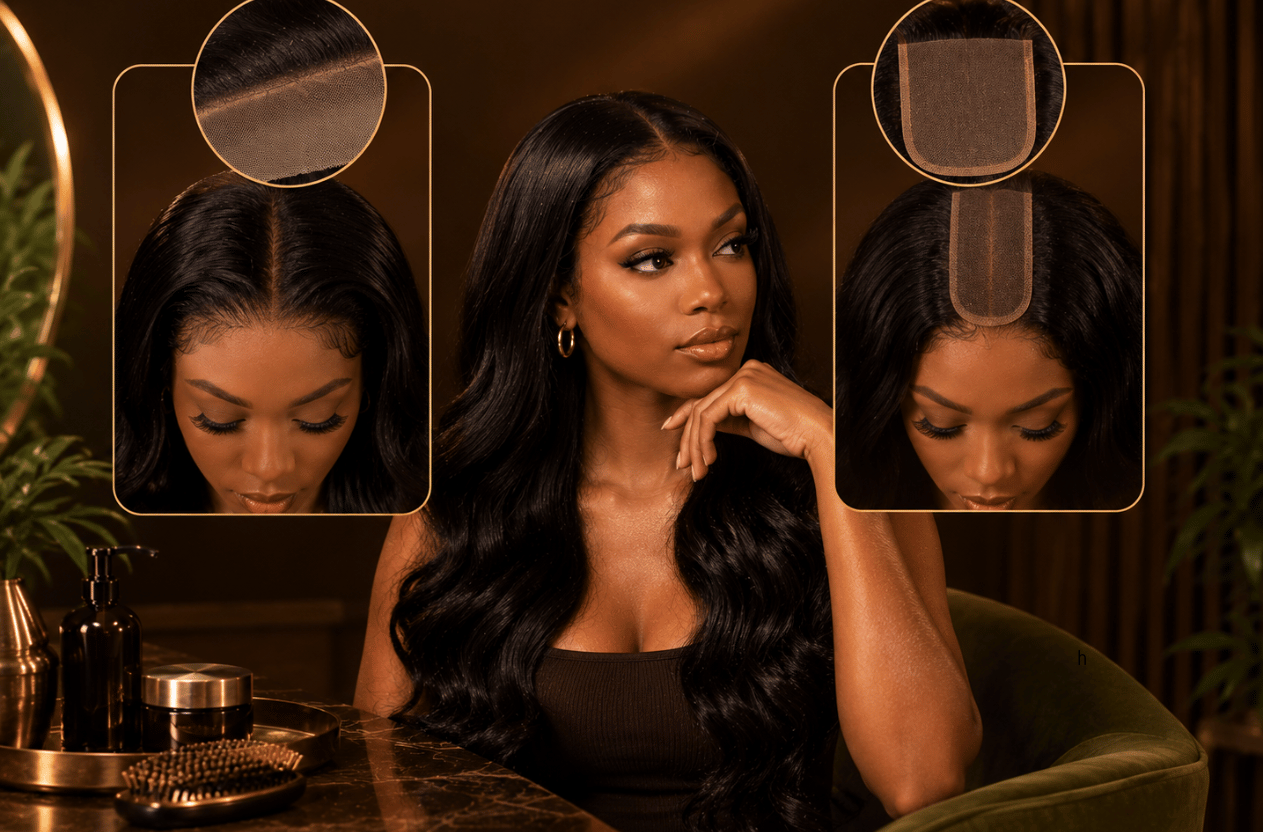
The piece at the front of your install is the first thing everyone sees, and it decides how natural, flexible and easy your whole look turns out.
Picture this. You’ve picked your texture. You’ve chosen your length. Your cart is full and you’re feeling good. Then you spot two words on the product page that stop you in your tracks: frontal and closure.
They look alike. They sit in the same spot. They’re often sold side by side. So which one do you actually need?
If that’s your question, you’re in good company. Almost everyone new to hair extensions gets stuck right here, and it isn’t because it’s hard. It’s because nobody ever explains it in plain language. Until now.
Here’s the big idea. Your bundles make up most of your look, but the piece at the front is what people see first. It frames your face. It decides how you can part your hair. And it’s what makes your style look like it grows from your own head. That’s why frontal vs closure: which is right for you? is one of the smartest questions you can ask before you buy.
In this guide we’ll walk you through what each piece is, how they’re different, what they cost you in time and money, and how to choose. No confusing jargon, promise. If you’re still choosing your curl pattern, our texture guide is a great place to start, and our hair length guide will help you get the size right. Then come back here for the part that frames your face.
Frontal vs closure: which is right for you? The short answer
Let’s give you the answer in one breath first, and then we’ll unpack it.
A closure is a small piece that covers the top of your head, usually the spot where you part your hair. A frontal is a longer piece that stretches across your whole front, from one ear to the other, so it covers your hairline too.
If you want something simple, quick and kind to your budget, a closure is probably your friend. If you want to wear your hair pulled back, swept to the side or parted in different places, a frontal is probably your friend. That’s the quick version of frontal vs closure: which is right for you? Keep reading to find out where you land.
What is a closure, exactly?
Imagine you’ve had bundles sewn in all over your head. You’d have a gap at the top, right where your part goes. The closure fills that gap. It’s called a closure because it literally closes up the top of your style.
Here’s what you need to know:
• It’s small. Think about the size of your palm. It covers the top of your head and not much more.
• The part is mostly decided for you. You usually choose a middle part, a side part or a free part when you buy it, and that’s the look you’ll wear.
• Your hairline stays where it is. The closure sits a little behind your own hairline, so the front of your style blends in with your natural hair.
• It’s quicker and simpler. Because it covers less, it takes less time to put in and usually costs less.
A closure is a lovely choice if you’re new, if you like the same part every day, or if you’d rather keep things easy. The trade-off is freedom. You can’t pull your hair into a high ponytail and show off a whole new hairline, because the closure doesn’t go that far forward.
What is a frontal, exactly?
Now imagine a curtain across the front of your head, running from the top of one ear, across your forehead, to the top of the other ear. That’s a frontal.
It does something a closure can’t. It creates your hairline. That means the hair at the very front of your face comes from the piece itself, so it can look like it’s growing straight out of your skin.
• It’s wider. It stretches ear to ear, so it covers much more of your front.
• You can part it anywhere. Middle, left, right, zig-zag. You choose, and you can change your mind next week.
• You can pull your hair back. Ponytails, buns and half-up styles all work, because the hairline is part of the piece.
• It needs more time and care. It’s bigger, a little more delicate and usually stuck down along your hairline, so putting it in and taking it off takes patience.
A frontal is perfect if you love changing your style, if you want a full, natural-looking hairline, or if you’re planning to wear your hair up now and then. The trade-off is that it costs more and asks for more attention.
Frontal vs closure: which is right for you? The main differences, side by side
Let’s put them next to each other so the picture gets clearer.
• Size. A closure covers the top of your head. A frontal covers the whole front, ear to ear.
• Parting. A closure gives you one fixed part. A frontal lets you part your hair almost anywhere.
• Hairline. With a closure, your own hairline stays in charge. With a frontal, the piece creates a new hairline for you.
• Pulling hair back. A closure keeps your hair down and forward. A frontal lets you wear it up and off your face.
• Time. A closure is quicker to install. A frontal takes longer because there’s more to fit and blend.
• Price. A closure usually costs less. A frontal usually costs more because it’s bigger and takes more work to make.
• Care. A closure is easy going. A frontal needs a bit more love around the hairline.
Neither one is better in every way. Each is good at something different, so the goal is to pick the one that fits your life.
Which one looks more natural?
This is the question we hear most, and the honest answer is: both can look gorgeous, and both can look fake if they’re rushed.
A frontal has the bigger payoff. Because it makes your hairline, it can look like your own when it’s done well. It also has more places to go wrong. If the edge is too thick, too straight or the wrong shade, people can spot it from across the room.
A closure is more forgiving. It sits further back, so it’s easier to blend into your own hair. If you want a natural look without much fuss, it’s a safe bet.
Whichever you choose, three little things make the biggest difference:
• Match the shade. The thin, net-like base should match your skin tone so it melts in instead of showing up.
• Keep the edges soft. A hairline that looks too sharp or too even is a giveaway. Real hairlines are a little uneven.
• Blend the front. A little of your own hair blended into the front helps everything look like one piece.
How you can style each one
Here’s where your daily life matters. Ask yourself how you’ll really wear your hair.
If you wear your hair down, with the same part, most days, a closure covers everything you need. It’s simple, and the style stays tidy.
If you like to switch things up, a frontal gives you room to play. Slick it back for a night out. Sweep it to one side for work. Put it up in a ponytail for the gym. You’re not stuck with one look.
Here’s a good test. Picture your next three outfits or occasions. Do they all work with your hair down and the same part? Closure. Do you picture your hair up at least once? Frontal.
Time, price and upkeep
Let’s talk about the practical stuff, because it matters just as much as the look.
Time. A closure install is usually quick. A frontal takes longer because your stylist has to fit it carefully along your hairline and blend it in. If you’re short on time, or if sitting for a long appointment isn’t your thing, keep this in mind.
Price. A frontal costs more than a closure, and the install often costs more too. If you’re watching your budget, a closure lets you get a beautiful look without stretching.
Upkeep. A closure is easy. A frontal needs more attention. The front is the most visible part of your style, so you’ll want to check it often, keep it clean and take your time when you remove it.
Here’s something worth knowing: a pricey piece on a weak foundation still won’t last. The strip that holds your bundles together matters just as much as what sits on top. If you want to know why, read our guide to understanding wefts and then come back.
How each one feels to wear
Looks aren’t everything. You’ll be wearing this for weeks, so comfort counts.
A closure is small and light, so most people forget it’s there. A frontal is bigger, so you may notice it more in the first few days, especially around your forehead and ears. That feeling usually settles as you get used to it, much like a new pair of shoes.
If something feels tight, itchy or hot, don’t just put up with it. Tell your stylist. A good fit should feel snug and secure, never sore. Comfort is a sign your install is sitting the right way, and it’s the best reason to speak up early.
Your hairline matters: keeping your own hair safe
Your own hair is the real star here, so let’s protect it.
Whatever you choose, the front of your head is a delicate place. The hair along your hairline is fine and easy to damage. Anything that pulls on it too tightly, for too long, can cause it to thin out. According to the American Academy of Dermatology, hair loss from tight styles can become
permanent if it’s ignored, which is why they suggest checking your hairline every month for early warning signs.
A few habits help:
• Ask for a gentle install. It should feel snug, never painful. Pain is a sign to speak up.
• Give your hairline a break. Don’t wear the same piece for months without checking underneath.
• Take it off carefully. Rushing removal tugs at your own hair. Take your time, or let your stylist do it.
• Look after your scalp. Keep it clean and moisturised so your natural hair stays strong.
If you spot little broken hairs, a thinner edge or sore spots, take the piece out and let your hairline rest.
Don’t forget your bundles
A frontal or closure never works alone. It teams up with your bundles to finish the look, and the two need to match in texture, colour and length.
Both a closure and a frontal cover a different amount of your head, so the number of bundles you need can change with your choice, your length and how full you want it to look. There’s no one answer for everyone. We’ve put it all in one place in How many bundles do I really need? so you can work out your number before you check out.
A good rule of thumb: decide on your front piece first, then work out your bundles. That way, you won’t end up with too little hair or a pile of leftovers.
Frontal vs closure: which is right for you? Find your situation
Find yourself in the table below, or head straight to shop closures or shop frontals if you already know which one you want.

Can’t decide? There’s a middle route. Plenty of first-timers start with a closure, learn what they like, and move to a frontal next time. It’s a great way to ease in without a big commitment.
Simple ways to look after whichever you choose
Even the best front piece lasts longer with a little care. A few simple habits go a long way:
• Brush gently. Start at the ends and work upward so you don’t pull on the front.
• Wash with care. Use lukewarm water and smooth the shampoo downward. Don’t scrub the front.
• Pat dry. Don’t twist or wring. Press the water out and let it air dry.
• Protect it at night. A silk bonnet or satin pillowcase cuts down on rubbing and tangles.
• Go easy on heat. Too much heat can damage the thin base and the hair.
• Keep up your touch-ups. Regular check-ins with your stylist catch small problems early.
Common mistakes newbies make (and how to skip them)
Everyone starts somewhere. These are the slip-ups we hear about most, and each one is easy to avoid.
• Choosing only by price. The cheapest piece can cost you more if it looks unnatural or wears out fast.
• Buying a frontal you’ll never use. If you always wear your hair down with one part, a closure may be all you need.
• Picking the wrong shade. A base that’s too light or too dark stands out. Match it to your skin.
• Rushing the install. The front is the most visible part, so it deserves the most time.
• Forgetting about your own hair. Your hairline is precious. Protect it first, then style it.
Reading a product listing without getting confused
Product pages love fancy words. Here’s how to cut through them.
If a listing only shows styled, curled, glossy photos, ask for a close-up of the front piece. A brand that’s proud of its work will happily show you.
Look for clear answers to these questions: How wide is it? Can I part it where I like, or is the part fixed? What shade is the base, and does it come in more than one? How should I look after it? If all you get back is “premium quality”, it’s fair to ask for more. A brand that knows its product will tell you plainly.
FAQ On frontal vs closure: which is right for you?
Is a frontal better than a closure?
Not always. A frontal gives you more freedom and a fuller hairline, but a closure is simpler, quicker and often cheaper. Better depends on your life.
Can I pull my hair into a ponytail with a closure?
Not in the same way. A closure sits behind your hairline, so you’ll see the edge if you pull everything back. If ponytails are a big part of your life, look at a frontal.
Which one is easier for beginners?
A closure. It’s smaller, quicker to put in and easier to look after, so it’s a gentle way to start.
Which one lasts longer?
It depends on the quality and how you care for it. Either one can last through several installs when it’s handled gently and cleaned properly.
Can I switch from a closure to a frontal later?
Yes. Lots of people start with a closure and move up once they know what they love.
Do I need the same texture for my front piece and my bundles?
Yes, ideally. Matching them is what makes the whole thing look like one head of hair. Our texture guide walks you through it.
Making your choice with confidence
On day one, a great front piece and an average one can look almost the same. The difference shows up a few weeks later, when one is still sitting flat and natural and the other has started to look tired. So here’s the simple version to take with you. Choose a closure if you want easy, quick and budget-friendly. Choose a frontal if you want freedom, a full hairline and the chance to wear your hair up. Think about how you really live, not just how you want to look in one photo.
That’s the heart of frontal vs closure: which is right for you? It isn’t about which is fancier. It’s about which one fits your days.
Ready to put it all together? Browse our range and shop hair bundles in the texture and length that suit you, then add a closure or frontal to finish the look.