

Three little labels on a product page, and the reason two bundles at the same price can behave nothing alike.
Picture this. You open a hair website and every bundle you click on says something different. “Raw.” “Virgin.” “SDD.” One listing says “100% human hair,” the next says “premium virgin SDD,” and the prices are all over the place. You have no idea whether the expensive one is really better, or whether someone just got creative with the product title.
Don’t worry, you’re not the only one. Almost every newbie hits this wall, and it’s not your fault. Hardly anyone stops to explain what these words mean.
Here’s the good news. Once you understand raw, virgin, SDD, a product page stops looking like a secret code. You’ll know what’s being promised, what isn’t, and which questions to ask before you spend any money.
In this guide we’ll walk you through what each label means, how they fit together, how to check hair for yourself, and how to pick the one that suits you. No confusing jargon, promise. And once your hair arrives, our guide on how to make your hair last longer will help you protect what you paid for.
Raw, virgin, SDD: what do these words actually mean?
Let’s start with an easy picture. Imagine you’re buying eggs. One carton says “farm fresh.” Another says “from one farm.” A third says “nothing added.” They’re all eggs, but each label is telling you something different about where the eggs came from and what has been done to them.
Raw, virgin and SDD work the same way. Each one answers a different question:
- Raw tells you how natural the hair is. Think of it as hair that has been touched as little as possible.
- Virgin tells you whether the hair has been changed with chemicals, like dye or anything that alters its natural shape.
- SDD tells you who the hair came from: one person, or lots of different people mixed together.
Here’s the part most newbies miss. These three words are not steps on a ladder. They don’t compete with each other. They describe different things, so one bundle can be all three, two of them, or none. That’s the big idea behind raw, virgin, SDD: three different questions, three different answers.
Raw hair: as close to nature as it gets
Raw hair is hair that has been left as natural as possible. It hasn’t been dyed, it hasn’t been given a new curl or wave, and it hasn’t been softened up with anything to make it look shinier in the photo. What you get is the hair the way it grew, with its own natural texture, its own natural shade and a slightly more real, less “perfect” look.
That’s why raw hair tends to blend so well with natural hair. It moves like real hair because it is real hair, without a lot of extra work done to it. You might notice small differences from strand to strand, like a slightly different shade. That’s not a flaw. It’s a sign the hair hasn’t been forced to look uniform.
Now for the honest bit. “Raw” isn’t an official label with a rulebook behind it. Sellers use it in different ways, and some use it as a fancy word for good-looking hair. So treat “raw” as a promise you should ask about, not a guarantee you can relax on. We’ll show you exactly how in a moment.
Want to see it for yourself? Take a look at our shop raw hair bundles.
Virgin hair: never been chemically changed
Virgin hair has one simple meaning: it has never been dyed, bleached or treated with chemicals. Nothing has been done to change its colour or its natural structure. It’s still the same hair that left the donor’s head.
Here’s where it gets a little tricky. Some sellers take virgin hair and give it a wave or curl pattern using steam or heat, then still call it virgin. The hair itself hasn’t been dyed, so some people say the label still fits. But those patterns can loosen after a few washes, and many buyers feel surprised when their curls relax. So if you’re buying curly or wavy virgin hair, ask whether that pattern is natural or added.
Colour is another thing to watch. If a bundle is sold as “virgin blonde,” the hair has usually been lightened, and according to one hair industry vendor interviewed by NaturallyCurly, hair that has been coloured is no longer considered virgin. That doesn’t make it bad hair, but the label may not mean what you expected.
You can shop virgin hair bundles in natural shades to compare.
SDD hair: all from one person
SDD stands for “single donor draw.” It means all the hair in your bundle came from one person. Not ten people, not fifty. One.
Why does that matter? Picture a box of crayons where every crayon is the same colour from the same batch, compared with a box where you’ve tossed in crayons from five different sets. The first box matches perfectly. The second one looks a little off, no matter how pretty each crayon is.
Hair works the same way. When all the strands come from one person, they tend to match in thickness, shade and the way they move. That usually means smoother blending, fewer tangles and a bundle that ages evenly.
SDD hair usually costs more because it takes more work to collect and keep together. You can shop SDD hair bundles to compare.
How raw, virgin, SDD fit together
Since these three labels answer three different questions, here’s an easy way to see how they overlap. Find the label on the left, and read across to see what it actually promises.
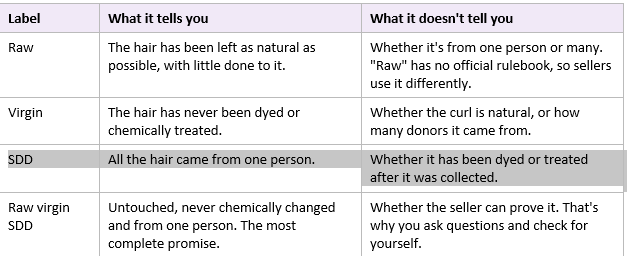
So when you see “raw virgin SDD” on a listing, it’s saying the hair is untouched, never chemically changed and all from one person. That’s the most complete version, and it’s also why that kind of bundle usually has the highest price tag. But a listing that only says “virgin” or only says “SDD” isn’t automatically worse. It just tells you less, and you’ll want to ask about the rest.
Why raw, virgin, SDD matters before you buy
When you shop for hair, you’ll see plenty about texture, length and colour. Those are the things you can see in a photo. What the hair has been through, and how many people it came from, is different. You can’t judge it from a picture, and once the hair is installed it’s too late to ask.
But it affects things you will definitely notice:
- How long it lasts. Hair that hasn’t been through harsh treatment tends to hold up better through washing, styling and months of wear.
- How much it tangles. Mixed hair from many donors can tangle more, because the strands don’t all behave the same way.
- How natural it looks. Hair that still has its natural movement and slight variation blends in far better than hair that looks too perfect.
So two bundles can share the same texture, the same length and nearly the same price, and still give you two very different experiences. Understanding raw, virgin, SDD is what explains why.
The honest truth: nobody checks these labels
This is the part brands rarely say out loud. The hair extension world doesn’t have one official rulebook for words like raw, virgin and SDD. As one seller told NaturallyCurly in an interview, the industry isn’t regulated, so the same word can mean different things to different vendors.
That doesn’t mean everybody is dishonest. Plenty of sellers are careful and proud of their hair. It simply means the label alone can’t be your proof, so ask questions and check for yourself.
Words that sound impressive but don’t tell you much
Here’s how to read a few common product page words without getting confused.
“100% human hair” sounds like a promise, but it only tells you the hair isn’t synthetic. It says nothing about whether it’s raw, virgin or SDD. Almost every real human hair bundle can say it.
Grades like “10A” or “12A” look scientific, but there is no shared standard behind them. One seller’s 12A can be another seller’s 9A. Treat them as marketing, not measurement.
“Double drawn” is about length and fullness, not about how natural the hair is. It’s a different thing entirely, so don’t mix it up with raw, virgin or SDD.
And if a listing only shows curled, glossy styled photos, ask for a close-up of the hair in its natural state. A brand that’s proud of its work will happily show you.
Four easy ways to check raw, virgin, SDD hair yourself
You don’t need special tools, just your hands and a bit of water. None of these is perfect alone, so use them together.
1. The close-up look
Look at the hair in good daylight. Real hair has small natural differences, like slightly different shades and strands that don’t all end at exactly the same point. If everything looks identical, glossy and a little too perfect, ask more questions.
2. The touch test
Run your fingers down a few strands, then back up. Good hair feels soft and moves freely. Hair that feels slippery, coated or oddly stiff may have had something added to make it feel better than it is.
3. The gentle tug test
Take a small handful and give it a light, steady tug. A few stray hairs coming away is normal. Lots of strands coming out easily is a warning sign, and a good reason to be cautious about how it was put together.
4. The wash test
Wash a small section the way you plan to look after your hair, then let it dry fully. Compare it to how it looked before. If the curl or wave drops out, the shine disappears or the hair turns frizzy, that pattern was probably added, and it won’t last through weeks of real life. It’s best to do this before you commit to a full install.
What to ask the seller before you buy
Whenever you’re choosing hair, from us or anyone else, these are good questions to keep in your back pocket:
- Is this hair raw, virgin, or both? What do you mean by that?
- Is the curl or wave natural, or was it added?
- Is it SDD? How do you know the hair came from one person?
- Can I see a close-up photo or short video of the hair, without styling?
A brand that can answer these clearly and confidently knows its product inside out. If all you get back is “premium quality,” it’s fair to ask for more. Understanding raw, virgin, SDD gives you the confidence to do exactly that.
Raw, virgin, SDD: which one is right for you?
There is no single “best” label for everyone. The right pick depends on your budget, your hair and how you plan to wear it. Find your situation in the table below, or head straight to shop hair bundles if you already know what you need.
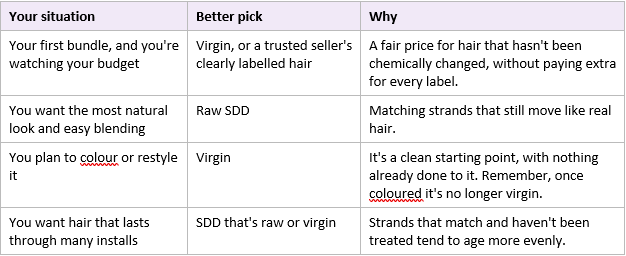
Can’t decide? You don’t have to go all in. Start with one good bundle in the label that matters most to you, then upgrade later. And our guide to understanding wefts is a great companion to this one, because the best hair in the world still needs a well-made base.
How to keep raw, virgin, SDD hair lasting longer
Here’s something that surprises a lot of newbies. Even the best hair in the world won’t last if it’s treated roughly. Raw, virgin and SDD hair has a head start, but how you look after it decides how long it stays beautiful.
Our full guide on how to make your hair last longer covers everything step by step, but here are the basics:
- Brush gently, from the ends up. Start at the bottom and work upward so you don’t yank on the hair.
- Be kind when washing. Use lukewarm water and smooth the shampoo down the length instead of scrubbing.
- Pat dry, don’t twist. Wringing out wet hair stretches and breaks it.
- Protect it at night. A silk bonnet or satin pillowcase cuts down on rubbing and tangles.
- Go easy on heat and chemicals. Dermatologists list too much heat and too many chemical treatments among the everyday habits that damage hair, and extensions are no exception.
If you only read one more guide after this one, make it how to make your hair last longer.
Common mistakes newbies make with raw, virgin, SDD
These are the slip-ups we hear about most, and each one is easy to avoid.
- Choosing only by price. The cheapest bundle can cost you more if it tangles, sheds or loses its curl and you have to buy again.
- Trusting one word. “Virgin” alone doesn’t tell you whether it’s raw, and “SDD” alone doesn’t tell you whether it’s been treated. Ask about all three.
- Judging by the styled photo. Curled, glossy pictures show you what the hair can look like, not what it really is. Ask for a close-up.
- Forgetting aftercare. Great hair on a bad routine ends up looking tired fast. Read how to make your hair last longer before your hair even arrives.
Where understanding raw, virgin, SDD really pays off
Understanding raw, virgin, SDD closes the gap between the hair you thought you were buying and the hair you actually get to enjoy. You’ll know what to ask, what to check and what’s worth paying for.
On day one, great hair and so-so hair can look almost identical. The difference shows up weeks later, when one bundle is still soft, smooth and easy to style and the other has started to tangle, frizz and lose its shape.
FAQ On raw, virgin, SDD
Is raw hair the same as virgin hair?
Not exactly. Raw describes hair that’s been left as natural as possible, while virgin means it has never been chemically changed. They overlap a lot, and good raw hair is usually virgin too, but sellers don’t always use the words the same way, so it’s worth asking.
What does SDD actually stand for?
SDD stands for single donor draw. It means all the hair in the bundle came from one person instead of being mixed from many.
Is SDD hair always better?
Not always. It usually gives you a better match, smoother blending and fewer tangles, but only if the seller is being honest about it. Ask how they know it’s from one donor.
Does virgin hair last longer?
It can, because it hasn’t already been through harsh treatment. But how you look after it matters just as much. Good care can stretch any hair a long way. Our guide on how to make your hair last longer shows you how.
Can I colour raw or virgin hair?
Many people do, but remember that once hair is coloured, it’s no longer virgin. If you plan to colour it, go to a trusted stylist and give the hair time to rest between treatments.
Ready to put it all together? Browse our range and shop hair bundles in the texture and length that suits you, then come back to how to make your hair last longer so it stays gorgeous for as long as possible.