
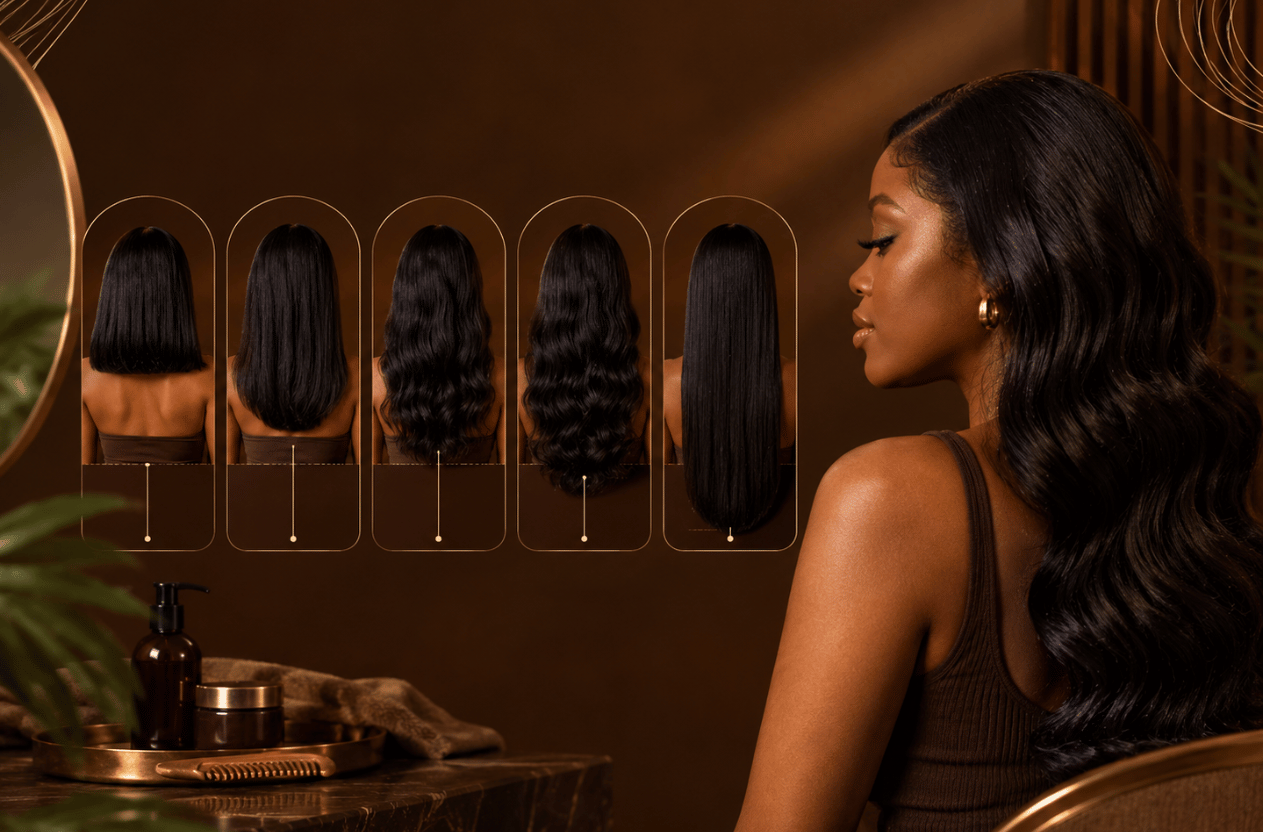
Almost everyone who has bought hair extensions has done this: you look at a length chart, pick a number with total confidence (eighteen inches, twenty-two inches, whatever the chart says will land at “mid-back”), and then your bundle arrives and looks nothing like the photo.
Here’s the good news: you didn’t pick wrong. The real problem is how length gets measured, and hardly anyone explains it before you check out.
A length chart shows where hair ends when it’s hanging perfectly straight next to a perfectly straight body. But real bodies aren’t straight lines. You have curves, shoulders that get in the way, and natural texture that swallows inches before you’ve even put the hair in. This hair length guide covers what most sellers skip: how length really looks once it’s on an actual person, why the same “twenty inches” looks so different on two different customers, and how to choose a length based on what you want to see in the mirror, not what a ruler says.
The tape measure only tells you half the story
Hold a bundle up to a tape measure and it will tell you the truth: this hair is twenty inches long, end to end, pulled straight. That number is real. But on its own it doesn’t help much, because a tape measure has no idea about your shoulders, your texture, your part, or the way your head tilts when you look in the mirror.
Length is measured on hair that’s hanging straight down and pulled completely straight. Your body isn’t built like that. Your shoulders curve outward. A ponytail sits higher than loose hair. Curls pull the hair up before it ever gets near your spine. None of that shows up on the chart, which is why two people can order the exact same twenty-two inches and end up with totally different looks: one grazes the bra strap, the other sits well past it.
There’s one more thing that changes how length looks, and if it’s new to you, it’s worth learning about before you shop by length at all. We cover exactly how bundles are sorted by length in What does “double drawn” actually mean?. Two bundles can have the same length on the label and look completely different once they’re in, because one is full and heavy all the way to the tips, and the other thins out long before it reaches the number on the tag.
Why the same number looks different on every body
A length chart only works if it accounts for the things that actually shift the number around. There are four of them, and sellers rarely mention them together.
Height and torso length
A five-foot-two frame and a five-foot-nine frame don’t wear twenty inches the same way. What matters most is your torso length (the space from your shoulders down to your waist), not your overall height. Someone with a long back will see the same bundle sit noticeably higher than someone with a short back, even at the same height.
Where your hairline actually starts
Length is measured from the top of your head, but most of us judge length by eye from our hairline, which sits lower. A high hairline can add what feels like an extra inch of length. A low one quietly takes that inch away.
Texture
This is the biggest one, and length charts almost never adjust for it. Straight hair hangs at its full length. Curly hair springs up as it dries, which is known as curl shrinkage. The tighter the curl, the bigger the difference: a twenty-inch curly bundle can look like only fourteen to sixteen inches once the curls settle in. If you’re not sure where your texture falls or how much shrinking to plan for, that’s exactly what we walk through in Which Texture Is Right For Me? Find the texture that fits your lifestyle and look — read that before you commit to a length, because these two choices really go together.
How the bundle is made
As we covered above, a single drawn bundle gets thinner toward the ends and tapers to a point, so its “advertised length” is really just its longest few strands, not the length you’ll actually see. A double drawn bundle (one where the short, thin strands have been taken out) with the same label looks fuller and longer for much longer, because it stays thick instead of thinning out early.
The body-landmark method (skip the ruler entirely)
The most reliable length shortcut has nothing to do with inches. It uses spots on your own body, because those don’t lie the way a chart does.
Collarbone length
About 10–12 inches from the top of your head, depending on your torso length. This is the shortest length that still looks like “long hair” instead of a bob.
Shoulder length
About 12–14 inches from the top of your head, depending on your torso length. This is the most forgiving length there is, and it works on almost every face shape and body.
Armpit length
About 16–18 inches from the top of your head, depending on your torso length. This is the most popular range, and it’s where your texture starts to matter a lot.
Mid-back length
About 20–22 inches from the top of your head, depending on your torso length. This is where how the bundle is made (single or double drawn) starts to change the look in a big way.
Waist length
About 24–26 inches from the top of your head, depending on your torso length. It’s hard to find this much length from a single person’s hair, so bundles here are almost always double drawn and often a mix of hair from different people.
Hip length and below
About 28 inches or more from the top of your head, depending on your torso length. At this length, the difference between single drawn and double drawn is impossible to miss.
None of these numbers are exact, because they shift with your own proportions. But they’re a much more honest hair length guide than a chart drawn on a mannequin, because you’re measuring against something that’s actually yours.
Why your own hair length isn’t the number to start from
Here’s what almost everyone thinks: “My hair is fourteen inches right now, so I’ll buy fourteen-inch extensions to match.” That almost always gives you a blend that’s shorter than you expected, and it has nothing to do with the extensions themselves.
Extensions go in a few inches below your natural hairline, not right at the root. If a row of hair is sewn or clipped in about an inch and a half down your head, it loses that inch and a half of length before it even starts. Buy the exact same length as your own hair and the blended result will look shorter than your natural hair alone. The usual fix is to buy one to two inches longer than your current length for a smooth blend, and two to four inches longer if you want the extensions to clearly add length instead of just adding fullness.
This ties back to texture. If your natural hair is curly and you’re blending it with straighter double drawn hair, or the other way around, you have to do the shrinking math twice: once for your own hair, and once for the hair you’re adding. That’s another reason length and texture can’t really be decided separately. It’s worth reading both guides side by side before you order, instead of picking a length first and thinking about texture later.
Four ways to test a length claim before it’s on your head
1. The wall-hold test
Stand with your back flat against a wall and have someone hold the bundle where it would actually sit once it’s in: a few inches below your natural hairline, not at your scalp. Mark where the ends land. This is far more accurate than holding the bundle up next to your face in a mirror, which makes every length look several inches better than it really is.
2. The dry-versus-wet check.
Ask the seller whether the length was measured wet or dry, and whether the hair was measured pulled straight or in its natural texture. Wet, stretched-out measurements are common, and they can make the hair look an inch or more longer on paper than it will be when dry, especially on wavy and curly textures.
3. The seated drop test.
Hair behaves differently when you’re sitting than when you’re standing: it bunches at your lower back and sits higher near your neck. If you’ll mostly wear your hair down while seated (desk job, long commutes), test how it falls while you’re sitting, not while you’re standing in front of a mirror.
4. The stylist consult.
A stylist who has put in extensions before can look at your body proportions and hairline and tell you in under a minute which of the landmark lengths above will land where you’re picturing. It’s worth doing before you order, not after, especially for mid-back length or longer, where the price gap between lengths starts to add up.
Matching length to what you actually want

Found your match in the table above? Shop by length and double-check the texture and whether it’s single or double drawn at checkout.
What length doesn’t tell you
A length label is just one detail among several, and like how a bundle is made, it says nothing about the rest. It tells you nothing about fullness: two bundles at the same length can look completely different depending on how they were made and how heavy they are. It tells you nothing about texture, which is the biggest reason a length “looks short” once it’s worn. That’s a separate question, answered in Which Texture Is Right For Me? Find the texture that fits your lifestyle and look, not this one. And it tells you nothing about how well the length will hold up after months of wear. That comes down to how healthy the hair’s outer surface is and how well you look after it, the same ground we cover in How to make your hair last longer.
Treat length, texture, and how the bundle is made as three separate questions you answer one at a time, not one decision made from a single chart. Get the length landmark right, check the texture shrinkage against it, and only then choose single drawn or double drawn based on the look you actually want.
FAQ HAIR LENGTH GUIDE
Is a length chart ever accurate?
Yes, for what it measures: hair pulled straight and hanging vertical. That’s rarely how hair actually sits on a body, though. Use the chart as a starting point, then adjust for your torso and texture using the landmark method above.
How much longer should I buy than my natural hair?
One to two inches longer for a smooth blend with no visible added length. Two to four inches longer if you want the extensions to clearly lengthen your look.
Does curly hair need a different length guide than straight hair?
The landmarks are the same, but the extra room you need isn’t. Curly and coily textures should add several inches to any target length to make up for the shrinking that happens once the curl settles.
Why do two people order the same length and get different results?
Torso proportions, hairline height, texture, and how the bundle is made all change the final look on their own. Length in inches is only one piece of the puzzle.
Does length affect how long a bundle lasts?
Not directly. How long hair lasts comes down to how healthy the hair’s outer surface is and how well it’s cared for, not its length. But longer lengths are harder to find from a single person’s hair, so they’re more often mixed or double drawn, and that does affect how the ends hold up over time.